


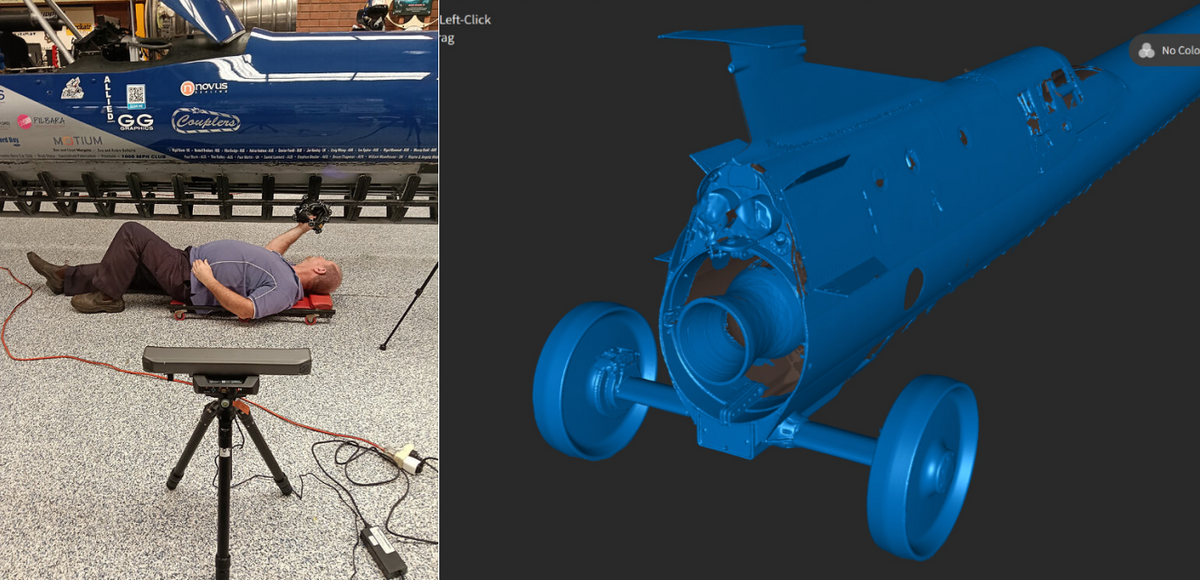
Aussie Invader is one of Australia’s most ambitious engineering projects: a rocket-powered vehicle designed to challenge the World Land Speed Record at speeds exceeding 1,000 mph.
Since 1984, the team has supported Aussie Invader with dimensional measurement, 3D scanning, and CAD modelling. For its latest development, the team needed an accurate digital reference of the existing vehicle to support the installation of a new rocket engine and fuel system.
Using the Revopoint Trackit SR 3D scanner, the team captured approximately 100 scans over three days, documenting critical internal mounting points alongside much of the vehicle’s exterior, suspension, airbrakes, and chassis structure.
The result is a detailed 3D reference that can help engineers design around the vehicle’s actual geometry as the project moves into its next stage.
The Challenge: Engineering Around a One-Off Vehicle
Aussie Invader is a unique prototype. There is no production equivalent or readily available CAD model that engineers can simply consult when planning new installations. The physical vehicle itself is a critical source of dimensional information.
The new rocket engine and fuel system must fit within an existing structure where mounting positions, component clearances, and surrounding geometry all matter.
Traditional tools such as rulers and calipers can capture individual dimensions, but they cannot easily document the complete spatial relationships between complex components.
The goal was to create a detailed 3D digital reference of the vehicle, allowing engineers to inspect and measure the existing structure during the design process without repeatedly returning to the physical car.

Why Trackit SR Was Suited to the Job
Scanning a large, tightly packaged vehicle requires more than capturing individual surfaces. The system must work across different scales, reach confined areas, and capture useful detail without making on-site preparation unnecessarily complicated.
The Revopoint Trackit SR combines optical tracking, wireless operation, and three blue laser scanning modes in a portable system. These capabilities are particularly relevant to complex engineering projects where the object is large, the working space varies, and access can be limited.

Marker-Free Scanning for a Complex Vehicle
Trackit SR uses optical tracking to follow the scanner’s position, enabling marker-free scanning without the time-consuming process of applying and removing tracking markers on the object.
For the Aussie Invader project, the team was able to scan the vehicle without applying tracking markers or scanning spray. This reduced surface preparation and clean-up while allowing the team to move between different scanning areas.
The vehicle included dark and metallic surfaces, suspension components, and tightly packed structural elements. Trackit SR’s blue laser modes are designed to capture complex geometry and dark or shiny surfaces without scanning spray, making them useful for demanding automotive scanning workflows.
Three Blue Laser Modes for Different Geometries
Not every part of a land speed record car presents the same scanning challenge. Large exterior surfaces, detailed mechanical features, and deep recesses require different approaches.
Trackit SR offers three switchable blue laser modes:
a. 30 blue cross laser lines for capturing detailed geometry.
b. 17 blue parallel laser lines for covering larger workpieces efficiently.
c. A single blue laser line for accessing deep holes, crevices, and grills.
This flexibility allows users to adapt the scanning approach to the geometry in front of them, rather than relying on a single mode for every area.
Trackit SR can capture up to 2 million points per second, supporting efficient data collection across both detailed features and larger surfaces.
Wireless Freedom for On-Site Scanning
Portability was another important consideration. The scanning equipment needed to move around the vehicle and access areas where cables or bulky equipment could make positioning more difficult.
Trackit SR’s 1 kg handheld scanner uses Wi-Fi 6 for wireless data streaming to a PC. Its wireless design helps reduce cable clutter, giving operators more freedom to move around the object and adjust their position as the work progresses.
For a vehicle with a large exterior and restricted internal areas, this flexibility supports a more adaptable on-site workflow.
Three Days, Approximately 100 Scans
Before scanning began, the team calibrated Trackit SR on site and selected the recommended Large object-size and Shiny or Black Material settings for the vehicle.
The work was completed over three days. Rather than attempting to capture the entire car as one enormous scan, the team divided the job into manageable sections and prioritised the geometry most relevant to the upcoming installation.
Lindsay Clarke carried out most of the scanning, beginning with the internal mounting points and surrounding structure needed for the new rocket engine and fuel system.
With the equipment on site, the team also captured additional areas to build a more comprehensive digital reference, including:
a. Exterior body: The bulk of the vehicle’s outer shape and configuration.
b. Suspension: Mechanical components and their surrounding geometry.
c. Airbrakes: Assemblies that form part of the vehicle’s wider engineering structure.
d. Internal chassis: Structural areas and mounting locations relevant to future design work.
By capturing more than the immediate installation area, the team created scan data with potential value for future measurement, design modifications, documentation, and reverse engineering.
The Toughest Area: Scanning Inside the Chassis Tube
The most challenging part of the project was scanning inside the chassis tube.
Restricted movement and limited visibility made it harder to maintain scanner tracking. There was less room to reposition the scanner, and fewer distinctive geometric features were available to support tracking.
This section required slower, more deliberate movements and careful adjustments to the scanner’s position.
The experience highlights an important consideration in 3D scanning: even with a capable system, object geometry, accessibility, and the scanning environment influence the technique required. Confined spaces may demand more careful handling than large, accessible surfaces.
The Result: A Digital Reference for the Next Engineering Stage
Over three days, the team completed approximately 100 scans using the Revopoint Trackit SR. The captured areas included the priority internal mounting points, much of the exterior body, the suspension, and the airbrake assemblies.
The resulting scan data provides the Aussie Invader team with a substantial three-dimensional reference of the vehicle as it exists today. Engineers can use it to inspect the captured geometry and support the design and positioning of the new rocket engine and fuel system.
The broader vehicle coverage also preserves useful geometry for potential future engineering work, reducing reliance on isolated manual measurements and repeated physical access to the car.
The engine and fuel-system installation remains the next stage of the project. The scans provide a foundation for that work, rather than a claim that the installation is already complete.
From Physical Geometry to Better Engineering Decisions
For a one-off vehicle like Aussie Invader, new systems must be designed around the physical structure that already exists. Accurate dimensional information is essential to making informed engineering decisions.
By combining optical tracking, flexible laser scanning modes, and wireless operation, the Revopoint Trackit SR helped Scan2Model capture critical mounting locations and a much wider range of vehicle geometry in a challenging on-site environment.
After more than four decades of involvement with Aussie Invader, the team’s objective remains unchanged: to understand the real vehicle accurately enough to engineer what comes next.
What has evolved is how that information can be captured. Portable 3D scanning gives engineers a more complete digital reference of complex physical structures, supporting design, modification, and future development.
Capture Complex Geometry with Trackit SR
From automotive engineering and reverse engineering to dimensional inspection and product development, the Revopoint Trackit SR helps you capture real-world geometry for your next engineering challenge.
Explore Trackit SR and find the right configuration for your workflow.
Use discount code REVONEWS26 at checkout to receive an additional 2–5% off your purchase, subject to the applicable promotion terms.
Frequently Asked Questions
What is the Revopoint Trackit SR used for?
The Revopoint Trackit SR is a wireless optical-tracking 3D scanner designed for applications such as reverse engineering, dimensional inspection, modelling, and automotive scanning. It can capture objects ranging from small components to large workpieces, with a recommended part-size range of 10 mm to 4 m.
How was 3D scanning used on the Aussie Invader land speed record car?
Scan2Model used the Revopoint Trackit SR to capture approximately 100 scans over three days. The primary objective was to document the internal mounting points and surrounding chassis geometry needed to support the planned installation of a new rocket engine and fuel system. The team also scanned much of the exterior body, suspension, and airbrake assemblies.
Can the Trackit SR scan without markers?
Yes. Trackit SR uses optical tracking to determine the scanner’s position, enabling marker-free scanning on the object. In the Aussie Invader project, the team reported that it did not need to apply tracking markers or scanning spray to the vehicle.
Can the Trackit SR scan black or shiny metal surfaces?
Trackit SR’s three blue laser scanning modes are designed to capture complex geometry, including dark and shiny surfaces, without scanning spray. Actual results depend on surface properties and scanning conditions, so particularly challenging surfaces should be assessed in the intended working environment.
Can the Trackit SR scan large vehicles and confined areas?
Trackit SR is designed for scanning both small and large objects, with a recommended part-size range of 10 mm to 4 m. Its handheld scanner supports flexible positioning around large objects. However, confined areas such as the inside of the Aussie Invader chassis tube can still require careful scanner movement because restricted access and limited geometric features may make tracking more challenging.
How long did it take to scan the Aussie Invader?
The scanning work took three days, during which the team completed approximately 100 individual scans. The time required for other projects will vary according to object size, geometry, accessibility, and the amount of detail required.
What can engineers do with 3D scan data?
3D scan data can provide a digital reference for measuring existing geometry, inspecting component relationships, supporting reverse engineering, and planning modifications. Depending on the software and workflow, scan data can also be used for dimensional inspection, CAD reconstruction, and design verification.
What accuracy does the Revopoint Trackit SR offer?
Revopoint lists a volumetric accuracy specification of 0.025 mm + 0.04 mm × L (m) for the tracking system, where L represents the tracking length in metres. The published specification is based on controlled testing; actual results can vary with the operating environment and scanning procedure. This figure should not be interpreted as a measured accuracy result for the Aussie Invader project.


Leave a comment
This site is protected by hCaptcha and the hCaptcha Privacy Policy and Terms of Service apply.