


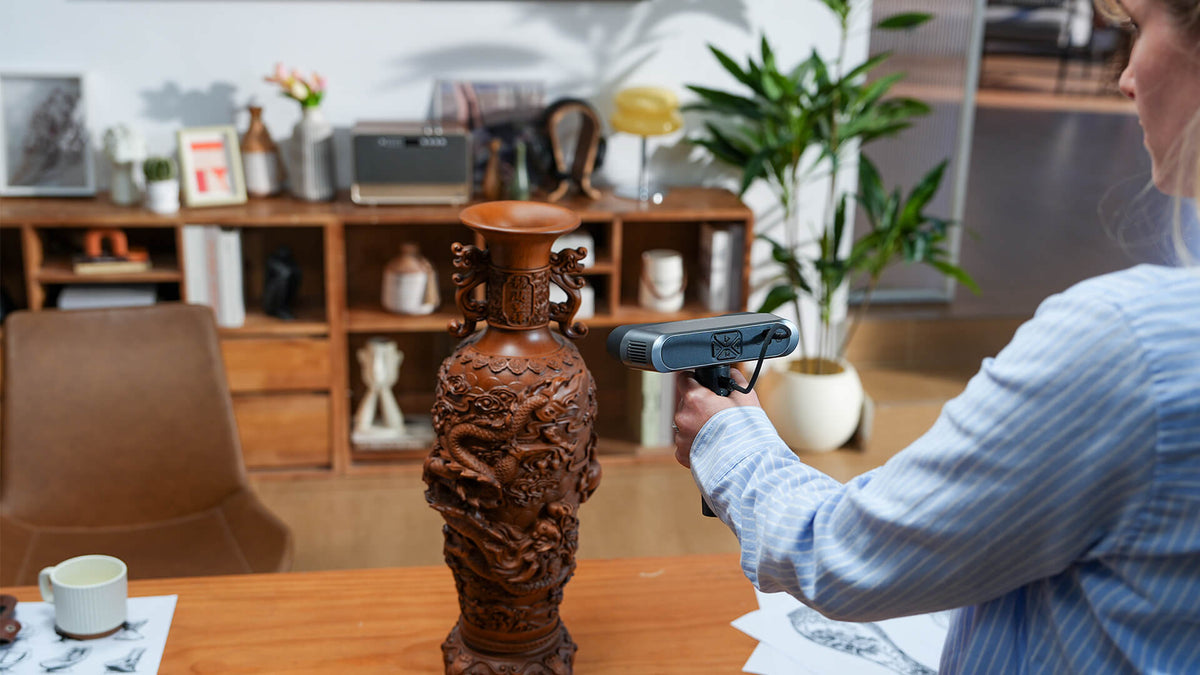
The Revopoint POP 4 has been making the rounds in maker communities, engineering forums, and 3D printing groups for a while now — and the conversation tends to go the same way: someone asks for a scanner recommendation under $1000, and the POP 4 comes up within the first three replies. That kind of consistent word-of-mouth usually means something. Here's a closer look at what's actually driving it.
Quick Verdict
Five scanning modes, 0.03 mm single-frame accuracy (laser mode), genuine outdoor capability, real-time AI segmentation, and a complete scan-to-CAD software ecosystem — all packed into a 286-gram device that fits in a jacket pocket. For product designers, reverse engineers, digital artists, and serious hobbyists, the POP 4 covers more ground than anything else at this price point.
Best for: Anyone who needs professional-grade scan quality without committing to a dedicated industrial setup.
What's in the Box
The Standard Edition ships with everything needed to get scanning on day one:

● POP 4 3D Scanner (160 × 30 × 72 mm, 286 g)
● USB Type-C to Type-C Data Cable (2 m)
● Tripod
● 200 Markers
● Mini Turntable
● Calibration Board
The Premium Edition adds a hard-shell carrying case, Battery Grip with power cable, magnetic Outdoor Blue Filters, and 300 additional markers (500 total). For anyone planning field or outdoor work, the Premium Edition is the more practical pick — the Battery Grip alone unlocks 4 hours of untethered scanning, which fundamentally changes how the device can be used on location.
Worth knowing: A common oversight for new users is skipping the initial calibration step. Running through the Calibration Board routine before the first scan — it takes only a few minutes — makes a measurable difference in point cloud consistency, especially for precision engineering work.
Design and Build
At 286 grams, the POP 4 is light enough that hand fatigue isn't a real concern even during extended sessions. The body is slim, with four physical buttons that handle the most common controls without requiring constant interaction with a connected device. That matters more than it sounds — when you're walking around a large object or holding an awkward angle, the last thing you want is to break your movement to tap a screen.
The scanner connects via USB-C (USB 3.0 speeds) and supports Wi-Fi 6 for wireless operation. Power comes from an external USB-C source or the optional Battery Grip, keeping the body compact without sacrificing the hardware inside.
The Five Scanning Modes — Each One Earns Its Place
Most handheld scanners in this category offer one capture method, maybe two. The POP 4 has five, and they're not variations on a theme — each one is genuinely optimized for a different scanning scenario.

1. High-Speed Multi-line Laser (30 Cross-lines)
Thirty blue cross-laser lines sweep the surface at up to 105 fps (with NVIDIA GPU acceleration), capturing up to 2 million points per second with single-frame accuracy of 0.03 mm. This is the mode that gets cited in engineering communities — that accuracy figure is normally associated with dedicated metrology hardware, not a handheld device under $1000.
It handles dark, shiny, and flat surfaces without scanning spray in most cases. Working distance sits at 200–400 mm, making it ideal for small-to-medium objects where surface detail is the priority.
Common mistake to avoid: Users who move the scanner too quickly in this mode often end up with tracking loss mid-scan. The POP 4's tracking is robust, but smooth, deliberate movement — especially around edges and corners — consistently produces cleaner point clouds than rushing through. Slowing down movement speed typically eliminates most re-scan situations.
2. Deep Hole Mode (Single Laser Line)
A single blue laser line reaches into recesses, grooves, and internal geometry that a wide-beam scanner can't access. Threaded holes, internal channels, undercut features — this is what makes the POP 4 viable for mechanical engineering workflows rather than just artistic capture. Most scanners at this price simply skip this capability entirely.
3. Full-Field HD Mode (Near-Infrared Structured Light)
Infrared structured light covers the entire capture area simultaneously, pulling in up to 5 million points per second at 20 fps — no markers required for objects with sufficient surface geometry. This is the go-to mode for faces, figurines, organic shapes, and anything where coverage speed matters more than sub-millimeter precision.
Common mistake to avoid: Placing markers on objects before using Full-Field HD mode is unnecessary and adds prep time. For objects with natural geometric variation — a face, a sculpted figure, most consumer products — the feature-tracking algorithm handles registration without any physical markers at all.
4. VCSEL Rapid Mode (Outdoor Structured Light)
VCSEL (Vertical-Cavity Surface-Emitting Laser) structured light is what makes outdoor scanning genuinely practical. Up to 30 fps, working distance out to 800 mm, and stable operation in ambient lighting up to 100,000 lux — that's direct midday sunlight. Marker-free feature tracking makes it fast to deploy for larger objects, full-body scans, or anything where placing markers isn't practical.
5. Hybrid HD Mode
Hybrid HD combines Full-Field and VCSEL capture in a single pass — the density of infrared structured light with the range of VCSEL. The result is fast, high-coverage point clouds with better surface fidelity than either mode alone. It's particularly effective for rapid prototyping workflows where a clean, watertight mesh is the goal and post-processing time needs to stay short.
Outdoor Scanning: A Genuine Differentiator
The ability to scan reliably in direct sunlight is rarer than the spec sheets suggest — many scanners that claim outdoor capability struggle above 20,000–30,000 lux. The POP 4's VCSEL mode operates cleanly up to 100,000 lux without any accessories. In multi-line laser mode, the scanner supports outdoor use up to 50,000 lux natively. With the magnetic Outdoor Blue Filter (included in the Premium Edition), the multi-line laser mode extends to 100,000 lux as well.

In practice, this means scanning vehicles, architectural details, outdoor sculptures, or large equipment on-site without scheduling around lighting conditions. For field documentation, heritage preservation, or any workflow that can't be brought into a studio, that's a meaningful operational advantage.
Wireless and Mobile Workflow
The POP 4 connects to Android and iOS devices over Wi-Fi 6. Full-Field HD and VCSEL modes run fully standalone on a compatible Android or iOS device — no laptop needed. Multi-line laser mode requires a PC connection for processing power, with the interface mirrored to the phone in real time via Revo Mirror, so the physical freedom of handheld scanning is preserved even when a PC is in the loop.
Compatible mobile hardware: Android with Snapdragon 8 Gen1 / Dimensity 9000 or equivalent (12 GB RAM, Android 11+), or iPhone X and later (iOS 14+, 4 GB RAM+, 64 GB storage+).
Software Ecosystem: From Raw Scan to Finished Model
The POP 4 comes with Revo Scan 6 — free, no subscription, fully offline. It covers capture, point cloud processing, mesh generation, and export in PLY, OBJ, STL, ASC, 3MF, GLTF, FBX, and Splat formats. Models come out ready to print or import directly into CAD tools.
Two additional tools extend the workflow further:
● Revo Design — CAD modeling and reverse engineering, built around scan data
● Revo Measure — Dimensional inspection and QC measurement

Third-party compatibility includes Geomagic Design X and Geomagic Control X for users already in those pipelines.
Real-Time AI Object Segmentation
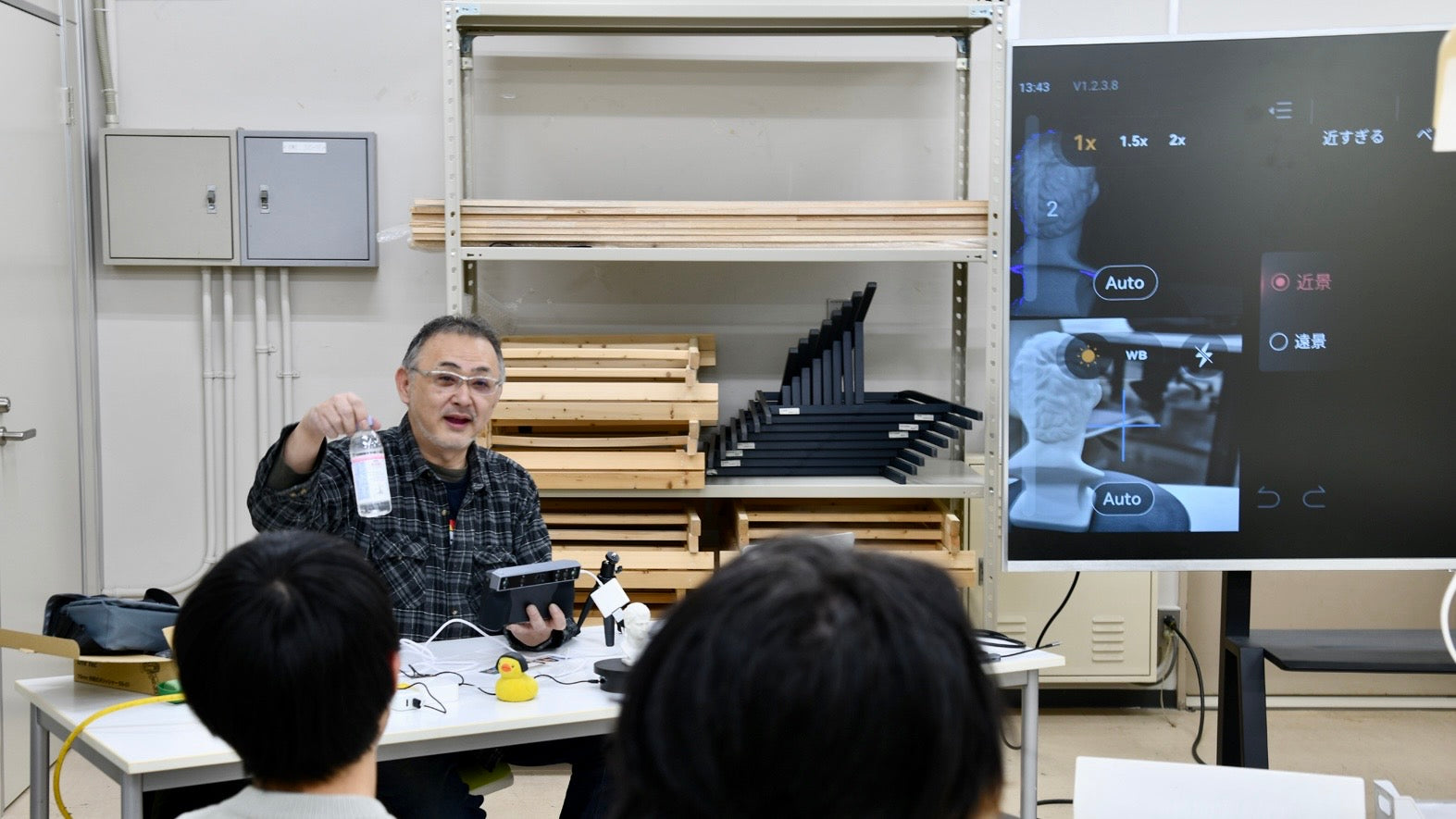
Revo Scan 6's AI segmentation automatically isolates the target object from its background during capture. For turntable scanning especially, this eliminates the manual masking step that used to add significant post-processing time. The scanner handles background separation on the fly — users who haven't tried this feature yet tend to be surprised by how much cleanup time it removes.
3D Gaussian Splatting (3DGS)
The POP 4 supports Revopoint's patented physically-scaled 3D Gaussian Splatting — converting point cloud and RGB data into photorealistic volumetric models at true 1:1 scale. Unlike standard mesh outputs, the physical scaling means the 3DGS output is metrically accurate, opening up applications in digital twins, immersive visualization, and virtual staging that traditional polygon workflows handle less efficiently.
Full Specifications
|
Specification |
Detail |
|
Technology |
Blue Multi-line Laser + Near-Infrared Full-field Structured Light + VCSEL Structured Light |
|
Single-frame Accuracy |
0.03 mm (Laser) / 0.08 mm (Full-field) / 0.10–0.20 mm (VCSEL) |
|
Volumetric Accuracy |
0.03 mm + 0.05 mm × L (m) |
|
Fused Point Distance |
0.05 mm |
|
Scanning Speed |
Up to 105 fps (Laser + NVIDIA GPU) / 20 fps (Full-field) / 30 fps (VCSEL) |
|
Point Return Rate |
2M pts/s (Laser) / 5M pts/s (Full-field) |
|
Working Distance |
200–400 mm (Laser) / 250–500 mm (Full-field/Hybrid) / 300–800 mm (VCSEL) |
|
Max Scan Volume |
2 × 2 × 2 m |
|
Min Scan Volume |
10 × 10 × 10 mm |
|
Outdoor Capability |
Up to 100,000 lux (VCSEL / Laser + Outdoor Filter) |
|
RGB Camera |
1.3 Megapixels |
|
Tracking Methods |
Feature, Marker, Global Marker, Color |
|
Connectivity |
Wi-Fi 6, Bluetooth 4.1, USB-C 3.0 |
|
Weight |
286 g |
|
Dimensions |
160 × 30 × 72 mm |
|
Battery Grip (optional) |
5500 mAh (~4 hours runtime) |
|
Output Formats |
PLY, OBJ, STL, ASC, 3MF, GLTF, FBX, Splat |
|
OS Support |
Windows 10/11 (64-bit), macOS 11.0+, Android, iOS |
Who Gets the Most Out of the POP 4
The POP 4 tends to show up most in workflows where a single scanner needs to handle multiple object types and environments. Product designers switching between small precision parts and larger assemblies. Reverse engineers who need 0.03 mm accuracy on mechanical components but also want to quickly capture reference geometry in the field. Digital artists scanning faces, props, and costumes for game or film pipelines. Educators running 3D scanning programs where one device needs to cover a wide range of student projects.
The five-mode architecture is what makes that breadth possible — and the AI segmentation and 3DGS support push it into territory that purely hardware-focused scanners at this price don't reach.
Common Questions
Does the POP 4 require scanning spray?
Not for most surfaces. The multi-line laser mode handles dark, matte, and moderately reflective surfaces without spray. Transparent objects (clear glass, acrylic) and true mirror finishes are the exceptions — a light coat of scanning spray on those surfaces gives the laser something to reflect from.
Can it be used entirely from a smartphone?
Full-Field HD and VCSEL modes run standalone on a compatible Android or iOS device. Multi-line laser mode connects to a PC for processing, with the scan interface mirrored to the phone via Revo Mirror — so the physical workflow stays mobile even when a PC is doing the heavy lifting.
How big a step up is it from the POP 3 Plus?
Significant. The POP 4 introduces two entirely new light sources — blue multi-line laser and VCSEL — that the POP 3 Plus doesn't have. Single-frame accuracy improves from 0.08 mm to 0.03 mm in laser mode, and outdoor scanning capability is new entirely. It's a platform upgrade, not an incremental update.
What are the PC requirements?
Minimum: Intel i7 13th Gen (or AMD Ryzen 7 5800), 16 GB RAM, NVIDIA RTX 3060 8 GB. For GPU-accelerated laser scanning at full speed, an Intel i9 12th Gen (or better) with 32 GB RAM and an RTX 4060 or better GPU is the recommended configuration. For macOS users, the minimum requirement is Apple M1 Pro/Max/Ultra with 16 GB RAM, and the recommended configuration is M3 Pro/Max/Ultra or better with 24 GB RAM.
Final Thoughts
The 3D scanning market at the sub-$1000 level has gotten more competitive, but the POP 4 holds a position that's genuinely hard to match: five distinct scanning modes, 0.05 mm fused point distance, outdoor capability that works in direct sunlight, AI segmentation built into the free software, and a scan-to-CAD pipeline that doesn't require third-party tools to complete. That combination in a 286-gram handheld is what keeps it coming up in recommendation threads — it's not hype, it's just a lot of capability in a small package.


Leave a comment
This site is protected by hCaptcha and the hCaptcha Privacy Policy and Terms of Service apply.